
Eco-anxiety is connected to feelings of isolation: not only a sense of disconnect from the vanishing natural world but also in terms of time. The future seems less and less predictable and the past appears suddenly remote, with nothing to say to the present. And it is true that we live in extraordinary times. The scale of the dangers we face is absolutely unprecedented.
But the climate has changed before and within recorded history: the ‘Little Ice Age’ of the 16th and 17th centuries is one example. By studying its history, we can find how other societies responded to climate breakdown, identifying the sources – whether cultural, technological, or communal – of success and failure. And at other moments in history, people have been concerned they might be damaging or even destroying their environment. Many indigenous cultures are centred in the belief that human beings depend on the natural environment which surrounds and supports them. Harming nature is dangerous and a form of self-harm. Ethics of respect and pro-environmental behaviours arise from that recognition of kinship.
In Western societies, the sense that we might be causing damage both to the planet and, therefore, to ourselves as well increased with the invention of industry in the eighteenth and nineteenth centuries. As Jeremy Davies shows here, it led to a first wave of environmentalism – one that we can bring to bear on present-day events and the anxiety they are producing.
Literature and the Industrial Revolution
Jeremy Davies, University of Leeds
It was ‘probably the most important event in world history’: both the escape route from an era of near-universal poverty and a precondition of today’s global ecological crisis. But what was Britain’s Industrial Revolution like for those who lived through it? And how did works of literature grapple with such a world-changing phenomenon?
One popular view has been that English literature and the Industrial Revolution had very little to do with one another. Imaginative writers were bound to recoil in horror at the first sign of smoky, polluting factories.
However, today’s scholars are reconstructing a more complex picture. They are finding that nuanced and well-informed representations of industrialism appeared in literary texts from the very start. English literature critiqued exploitation and environmental destruction without simply turning its back on the new industrial society.
During the Romantic period of literary history, the decades around 1800, ‘the progress of manufactures in Great Britain’ provoked ‘wonder and astonishment.’ Poets and essayists wrote about the nation’s changing landscapes, with their turnpikes, mines, canals, and burgeoning ports and cities. They assessed the human implications of what Samuel Taylor Coleridge called ‘the vast machines of Lancashire.’ Their views about this unprecedented ‘dominion over Nature gained,’ as William Wordsworth put it, were typically ambivalent. Literary authors produced urgent responses to the revolutionary innovations of the first industrial age.
Our website Writing the Industrial Revolution offers short, illustrated essays by academics from many different fields, written for new readers as well as for specialists. Through this site we aim to spark fresh thinking about the environmental dimensions and cultural legacies of the Industrial Revolution. The essays demonstrate that the literature of the first fossil-fuelled society can help us to imagine alternative environmental futures in our own troubled century.
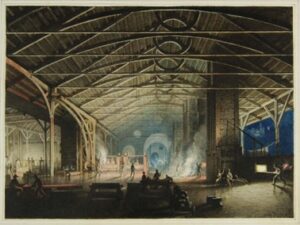
Penry Williams, Cyfarthfa Ironworks Interior at Night (1825). Wikimedia Commons.
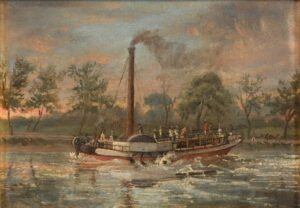
Alexander Nasmyth, The Comet (1816). Science Museum Group.
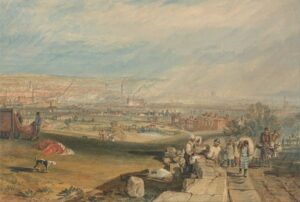
Joseph Mallord William Turner, Leeds from Beeston Hill (1816). Yale Center for British Art.
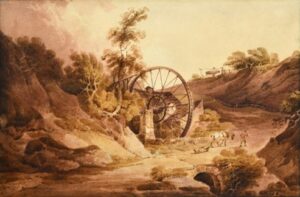
Paul Sandby Munn, Great Wheel, Broseley, Shropshire (c.1803). Ironbridge Gorge Museum Trust.


.jpg)