
By Hannah Green
Environmentalism focussed to start with on wilderness – on protecting areas still untouched by human activity. That was always questionable: describing somewhere as ‘untouched’ is a good way of denying the presence of indigenous people. Global heating now means, in addition, that everywhere is being affected by human beings; that nowhere remains untouched. This has led to a shift in emphasis from preservation to coexistence – from cordoning off and protecting some special places to learning to live with nature on our doorsteps. Farming is the human activity that transforms nature most extensively. Better coexistence with nature involves, therefore, a discussion of farming – how should it be conducted? Can we farm without overturning natural conditions? And does successful farming depend on a healthy natural environment?
In this post, Hannah Green, a doctoral student in Bristol, explores these questions in connection particularly with the rewilding movement – the idea that farmland needs to be returned to its wild state – and the controversies that has provoked. Hannah shows how much English studies can offer us amidst these sometimes impassioned debates.
When I tell people that my research is about farming and rewilding, the most common response I get is: ‘So… how is that an English PhD?’
My research is about landscapes and biodiversity, but more specifically about how literature articulates our cultural ideas about how we relate to the land. Do we see it as something to dominate, or as something to nurture? And do we see it as something that might express a national ideal of development or productivity, or as something that might have its own agency?
The kind of texts that can help us think through these questions come from a broad range of disciplines – cultural theory, ecology, anthropology, social history, and even economic theory. When you see literature as an expression of culture, or what Anthony Low might call a ‘cultural barometer’, then it becomes connected to all of these things, adding its voice to a many-stranded discourse that can help us better make sense of our world.
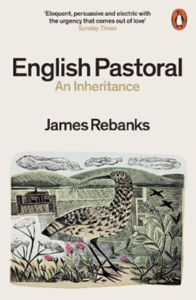
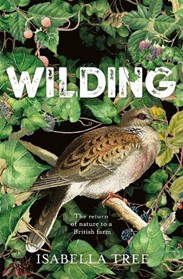
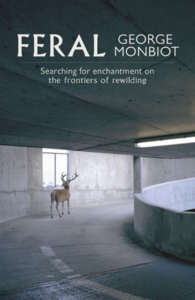
Several books about farming and rewilding have had a massive impact, not only in academia, but in public discourse, over the past few years, changing how we think about agriculture and nature. These books – Feral, by George Monbiot (2013), Wilding by Isabella Tree (2018) and English Pastoral by James Rebanks (2020) – have been instrumental in shaping public ideas, about what rewilding is, about the state of farming in the UK, and about how farmers can be seen as people who can protect and nurture the natural world, not just destroy it. (Feral – George Monbiot; Rebanks, English Pastoral (ISBN: 978-0141982571); Isabella Tree, Wilding (ISBN: 978-1509805105) – the book has been made into a film: Wilding; for more on Rewilding, go to: What is rewilding? | Rewilding Britain and What is rewilding and how is it relevant to climate change? – Grantham Research Institute on climate change and the environment).
Not only that, but these books have inspired a new wave of eco-critical thinking within academia about how this new mode of writing – one that Pippa Marland has described as ‘new georgic’ – can help us articulate and examine the knotty problems of how to live responsibly in a time of planetary crisis. (See Pippa Marland’s essay Rewilding, Wilding, and the New Georgic in Contemporary Nature Writing: Green Letters: Vol 24 , No 4 – Get Access)
Unlike the more well-known genre of the pastoral, which often presents idealised landscapes where humans go to rest and enjoy themselves, the georgic is a mode that is interested in farming and husbandry, hard work and practical knowledge. Taking its name from the Georgics, a series of poems written by Virgil in 29 BCE, this modern genre at once reflects ancient concerns, about how to live off the land, and incorporates a modern awareness of our planet’s fragility.
Approaching literature in this way isn’t just about looking at a text and reading it closely as a discrete unit of meaning – although this too can be rich and rewarding. Rather, it involves exploring how a text embodies the attitudes of the culture in which it was written, which are often so deeply held they go unarticulated, unexplored, and unchallenged.
Careful reading can bring these elements to the surface, even with just a few words.
Take, for example, this poem, ‘A Peasant’ (from Stones of the Field, 1946) by R. S. Thomas. It describes a farmer –
Iago Prytherch his name, though, be it allowed,
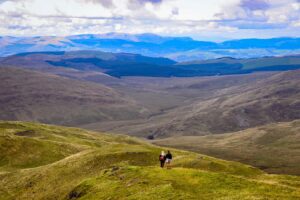
Just an ordinary man of the bald Welsh hills,
Who pens a few sheep in a gap of cloud
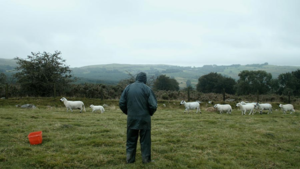
Thomas’ subject is a sheep farmer, who, at first glance, seems unremarkable, as Thomas himself says: ‘Just an ordinary man’. However, reading closer, the farmer seems to take on a mythical dimension. The poem ends by describing this farmer as someone who
season by season,
Against siege of rain and the wind’s attrition,
Preserves his stock, an impregnable fortress
Not to be stormed, even in death’s confusion.
Remember him, then, for he, too, is a winner of wars,
Enduring like a tree under the curious stars.
(available here: Poem Of The Week – A Peasant – R.S. Thomas; also in R. S. Thomas, Selected Poems (ISBN: 978-0140188905).)
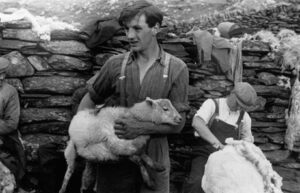
This landscape, seen through Thomas’s poem, is one of epic proportions, where the elements wage war and the farmer must fight for his survival, becoming himself a quasi-mystical figure, existing in a world that is closer to trees and stars than everyday human life. Because of this, our sense of awe extends to the landscape he inhabits, it becomes a place of drama and majesty.
Compare this, then, with George Monbiot’s description of the same landscape, those ‘bald Welsh hills’, the Cambrian Mountains, about 70 years later:
The land had been flayed. The fur had been peeled off, and every contoured muscle and nub of bone was exposed. Some people claim to love this landscape. I find it dismal, dismaying. I spun round, trying to find a place that would draw me, feeling as a cat would feel here, exposed, sat upon by wind and sky, craving a sheltered spot. (…) To me these treeless, mown mountains look like the set of a post-apocalyptic film. Their paucity of birds and other wildlife creates the impression that the land has been poisoned. Their emptiness appals me.
Now, instead of being an aggressor, the natural world is presented as a victim of human interference, in the particularly gruesome metaphor of flaying. Monbiot sees intensive grazing by sheep as the true threat to the landscape. Farming, then, is no longer a noble battle, where humanity ekes out a living in unforgiving conditions, but instead a destructive force, whose results are ‘post-apocalyptic’.
What has changed in the time between these lines were written, a lifetime apart? In tracing the differing attitudes of these writers, we can begin to understand not only their own unique viewpoints, but the way that the structure of society has changed, and how, alongside that, farming and the public opinions about farming have shifted too. By doing so, we might better see why Monbiot sees a landscape that is spoiled and degraded, dominated by the alien presence of sheep, whilst Thomas saw a natural expression of a farmer’s way of life, a distinctly Welsh existence.
Monbiot used the example of these bald Welsh hills, which he calls ‘the Cambrian desert’, to demonstrate the paucity of nature in the UK, and how farming, particularly upland sheep farming, had contributed to this. Making the case for rewilding as a solution, he proposed ending upland farming, restoring ecosystems, and reintroducing species such as lynx and beaver. Feral helped launch rewilding into the public consciousness, but to say that the term received a mixed reception would be an understatement. While broadly welcomed by naturalists and wildlife-enthusiasts, rewilding has been perceived as a cause for deep concern for many farmers, particularly in Wales. (Iain Bigg’s essay is one of the most well-worked out critiques of Monbiot: Essaying Self, Wilderness, and Place: a response to issues raised by George Monbiot’s Feral. (Part One) | Iain Biggs)
Carwyn Graves in their book, Tir: The Story of the Welsh Landscape (2024) (ISBN 978-1915279668; paperback to appear in February 2026)
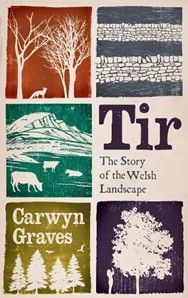
describes ‘the deeply held conviction that the [Welsh] land and its people are inextricably interlinked’ and points out two key words in the Welsh language – ‘habitat’ and ‘culture’. The book demonstrates that the words we use to talk about landscapes are loaded and important.
The first, cynefin (habitat), can mean ‘the stretch of mountain or hillside on which a flock of sheep are settled’, and is also used to refer to ‘a person’s native area’. As such, Graves writes, ‘the language itself naturally associates wild species to their ecological niche with domesticated animals’ home range and people’s own deeply rooted sense of home.’
The second word, diwylliant (culture) derives from the verb ‘diwyllio’, translated as ‘to cultivate’, ‘improve’, or ‘farm, and is ‘used both to refer to human culture and to agricultural practice’ – its linguistic composition renders it as literally to ‘unwild’.
Therefore, Graves continues: ‘the collective work of culture, in Welsh, is ‘un-wilding’ and to till land is to ‘unwild’ it. By this measure, the idea of turning over vast tracts of hill country to nature by removing farming and farmers from the picture, as rewilding has often been presented by the media, is the very antithesis of all that rural Welsh culture has stood for.’
Unwilding, rewilding, people, habitat, culture, place and farming – all of these terms are historically, geographically and linguistically meaningful, and far more complex than they might first appear. How they are deployed, what terms are used by whom, where and when, whether in poetry, novels, non-fiction works, political statements or marketing copy, can tell us a great deal.
Close readings can help reveal how one person can see sheep farming as a blight on an ancient landscape and wish to correct the ecological damage it has caused, whilst another celebrates the hard work and endurance such farming entails and is suspicious of any attempt to restore nature that might also involve removing people or changing land-use.
Engaging with literary studies means paying close attention to language and culture, and invites us to look closer, to engage meaningfully and carefully. We’re back to the idea of literature as a ‘cultural barometer’, something that can help us begin to unpick tangled webs of meaning, association and understanding, along with other disciplines, to illuminate current debates that have very real consequences for our landscapes, the cultures that have created them, and the communities who depend on them.


