By Michael Malay
Michael Malay’s Late Light won the Wainwright Prize in 2024. Here, Michael introduces this book ‘about falling in love with vanishing things’: Instagram And here’s Michael’s take on magpies (a successful co-habitant in human cities and one that is often maligned): Tweet of the Day – Michael Malay on the Magpie – BBC Sounds Michael posts here about discovering the environment’s energy and depths, its vastness and its vulnerability in the ordinary, everyday world of a city park, with his daughter.
Kite-flying in the Anthropocene
In 2007, a woman was swallowed by a cloud. Her name was Ewa Wiśnierska, and she was a paraglider. Earlier that day, she had launched her craft from Mount Borah, eastern Australia, and as she flew along the mountain’s northern ridge, which eventually gave way to open grassland, she was overtaken by a cumulonimbus cloud: a dense, anvil-shaped formation that towered 10 miles into the sky.
It was an unfortunate meeting. Prone to sudden moods and violent tempers, cumulonimbus are the unreasonable giants of the upper world, and within minutes, Wiśnierska was captured in what paragliders call a ‘cloud suck’, a powerful updraft at the cloud’s base. The updraft picked her up, flicked her like a toothpick, hauled her 10,000 metres into the air, and finally released her into the cloud’s upper reaches, where ice crystals immediately began forming in her hair. Data from her GPS shows that she climbed 10,000 metres in ten minutes, which means she was lifted up at nearly a mile a minute.
Wiśnierska soon lost consciousness – in the cloud she experienced temperatures of minus 50 degrees Celsius, chaotic winds, as well as a severe drop in air pressure – but somehow she lived to tell the tale. ‘You can’t imagine the power,’ she later told an Australian journalist, ‘you feel like nothing, like a leaf from a tree going up.’ She also recalled how, in the darkness of the cloud, sheets of lightning began to unravel right beside her. ‘I knew I was in the middle of the thunderstorm,’ she said, ‘and I could not do anything.’
(This Youtube documentary recounts her extraordinary experience: Miracle in The Storm (2010) – Ewa Wiśnierska Paragliding Documentary)

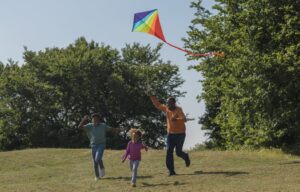
I had reason to think of Wiśnierska recently, during an afternoon of unsettled weather in east Bristol. A few days earlier, my daughter and I had made a kite – a simple construction of paper, kebab skewers and cellotape – but had struggled to make it fly: when we first took it to the park, the wind simply wasn’t strong enough. That afternoon, however, and seemingly with a mind of its own, the kite leapt onto a stair of wind, climbed rapidly up, and began darting to and fro like a crazed pendulum.
‘Go Sparkle Horse!’, my four-year-old shouted (this being her spontaneous name for the kite), and we watched as our craft, which a few moments ago had been a sleeping square of paper and wood, quickly dwindled into a leaf.
‘Dad,’ she said, ‘if we made the biggest kite in the world, like this big’ – she spread her arms – ‘could we fly too?’
‘Yes,’ I said, ‘we could.’ I then told her about hang-gliders and paragliders, about how they could stay airborne for hours, although the story about Ewa Wiśnierska I kept to myself.
‘Hooray,’ she shouted, ‘then I can be like Sparkle Horse!’
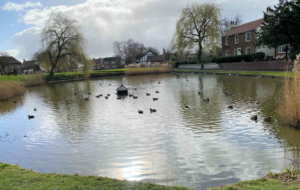
Having delighted in this image, she skipped away to the pond to feed the ducks, leaving me alone to fly the kite.
As I held the line, I fast became absorbed in the business of sky. The wind was coming from the south-west, as the winds in England generally do, and seemed particularly voluble that day, running past with loud sneezes, hacking coughs and umbrella-inverting blusters. In response, the kite danced and jigged, swung and boogied, arched up, fell down, swooped up once more, and as it wove together its small portion of sky, I suddenly felt the inadequacy of our usual depictions of the wind. On weather charts, wind is usually represented as a series of lines or arrows, or with the use of ‘wind barbs’ – a symbol which indicates wind speed and direction. When you fly a kite, however, you become aware of the wind as a restless three-dimensional prism, and the longer you stand there, the more you intuit, with your hand, the presence of dramatic airborne shapes: steep ramps of air, excitable wobbly spheres, sudden escalators, the falling edge of a shattered cliff. Something else can happen too: as you look up at all those miles of sky, you become aware of yourself inhabiting the bottom of an ocean rather than standing on the surface of the earth. For really we are in the depths here, on the floor of a vast layered sea of nitrogen, oxygen and argon, with hills and mountains rising around us like a kind of reef. In 2007, Ewa Wiśnierska had simply ascended into the upper reaches of that ocean before floating down again.
But of course, that sea contains other gasses too, not least one that is changing the balance of the earth, and as I stood in the park that day, watching the kite soar and twist, my mind began to wander. A part of it travelled backwards, to when I was a boy flying kites on a beach in western Java, while another part was tugged forwards, as I thought about the news on the radio that morning: in two or three days, a storm then brewing in the mid-Atlantic would reach the shores of England. And as soon as I thought about that storm, the boy in Indonesia was replaced by a girl (how old was she? – twelve, perhaps thirteen?) in a field in England. Very quickly the girl began to age (now she was twenty, now forty) and as she did the weather around her shifted, became at once stranger and stronger.
‘The height of the weather is the measure of man’, Paul Keegan and Alice Oswald write in Gigantic Cinema: A Weather Anthology (2020). By this they mean that the weather, which they memorably define as a ‘non-stop interruption’, is a part of our species-being: for as long as we’ve been around, we’ve lived in the weather and the weather has lived in us. If this is true, then the changing weather of our times – and our part in changing that weather – also affects our internal world. In fact, Keegan and Oswald go so far as to claim: ‘If the Anthropocene is us, and is upon us, we are being orphaned by it on a scale that has no measure.’
How to make sense of these experiences? What happens when that ‘non-stop interruption’ is refashioned beyond recognition, and what does it mean when even the simple act of kite-flying is haunted by such questions (questions a kite-flier from the start of the last century would never have asked?). And yet isn’t joy also part of our species-being, and don’t we find joy in the weather, and also, as any surfer, skier or sailor might attest, because of the weather? If that’s the case, then the medium above us, troubled though it is, can still be our parents in some way – unpredictable, but parents all the same. And we earth-children could still rise to the wind, and be raised by the wind, and feel joy (as well as complex foreboding at times) whenever we met it in the open – or indeed looked onto a windy landscape from a window. Window, from the Old Norse vindauga – literally, ‘wind-eye’: the opening that lets us feel the wind. Even indoors, the weather still reaches us – or put another way, a part of us is always outside. In one of his notebook entries, describing the ‘wild activity’ of thoughts, impressions and feelings that sometimes converged in his breast, Coleridge describes being lifted up on ‘a sort of bottom-wind’. A ‘bottom-wind’, which is perhaps a sibling to what paragliders call a ‘cloud suck’, and which, on a windy day, you can feel at the end of a darting kite.
***
I glance at the pond – and am returned to where I am. For the last few minutes, I’ve been so absorbed in the manoeuvrings of the kite that I’ve forgotten to check on my daughter. But there’s no need to worry – a quick scan reveals her bright red jacket, and in that strange way that sometimes happens between people who are close (is it the air that connects us?) she looks up at me in the same moment I look at her. I point at the kite, grinning stupidly, and she responds to my buoyant mood by throwing a handful of seeds into the air, much to the delight of the ducks.
‘Go Sparkle Horse!’ she shouts. ‘Go! Go! Go!’ And the ducks, suddenly frightened, take off too.
Paul Keegan and Alice Oswald, editors, Gigantic Cinema: A Weather Anthology (2022)
(ISBN: 978-0393540758). There’s also Alexandra Harris, Weatherland: Writers and Artists Under English Skies (2016) (ISBN: 978-0500292655)
For more information about the atmosphere, see:
Breathing Life into Earth: Understanding Our Atmosphere – SpaceDidYouKnow
National Geographic Education: Atmosphere
Gabrielle Walker, An Ocean of Air: A Natural History of the Atmosphere (2008)
(ISBN: 978-0747592907)
Turbulence:
Kites are blown around by the turbulence that occurs at low levels in the atmosphere. We all experience theunpredictable, gusty winds caused by the interaction between the atmosphere and the earth’s surface, at what is called the ‘atmospheric boundary layer’ or ‘planetary boundary layer’. The Met Office is actively researching this complex phenomenon (The atmospheric boundary layer – Met Office)
Higher up in the atmosphere, turbulence occurs around storm systems, over mountains, and close to the jet stream. Ewa Wisnierska was caught up in this kind of turbulence. It often affects aircraft and increasingly so: Why plane turbulence is really becoming more frequent and severe – BBC News