VENTURING OUT – 1
Professor Ralph Pite, Twentieth Century Poetry and Romantic Period writing (University of Bristol)
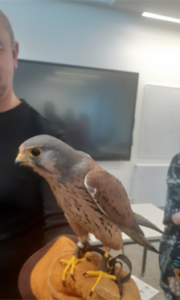
We were teaching an undergraduate course, ‘Writing the Anthropocene’, and reading Helen MacDonald’s H is for Hawk. It’s a wonderful account of learning to relate to a wild animal and the students loved it. But, we realised, many of them had never seen a hawk or a bird of prey, not close up, if at all.
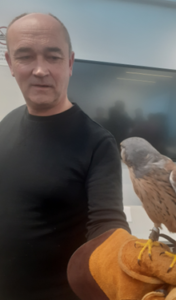
And when we were able to bring a local falconer onto campus, with this beautiful kestrel, the impact was transformative. I have never seen a group of students so focussed (I was very envious). Their sense of the creature’s otherness, its being, was deepened enormously and so was their understanding of the complex relationship between the human and the non-human.
It opened my eyes to the narrowness of my own teaching methods – my weddedness to classrooms, to text and discussion. It made me start thinking about how pedagogy needed to change in the environmental crisis. It made me want a falconer to go into every school.
But this was, I also realised, a highly privileged moment, made possible by my department’s discretionary budget and by the flexibility of a University timetable. And for us health and safety was not an issue either, as it might be elsewhere.
So, I began asking: how can we connect nature and every classroom?