
University English Book Prize 2022
We are delighted to announce the winner for this year’s Book Prize.
Francesca Brooks, Poet of the Medieval Modern. Reading the Early Medieval Library with David Jones (Oxford University Press).
This is an exceptional book that combines a wealth and depth of scholarship with an engaging writing style that draws even the non-specialist reader in. Focussed on The Anathemata, a work published by Faber in 1952 by autodidact, artist, and poet David Jones, it demonstrates through meticulous examination of archival materials and annotations from the Anglo-Saxon Library as well as from previously unexamined correspondence, the extent to which acts of reading and creative critical thinking on Jones’s part underpinned production of The Anathemata, a culturally and linguistically composite text that uses translation as a means of cultural renewal.
It makes an original contribution to both Medieval Studies and Modernism, the former in respect of Jones’s engagement with Old English which Brooks shows to have had ‘a far greater influence … than previously recognized’ on his work, the latter in respect of the archival turn in New Modernist Studies. It combines archival research and genetic criticism with a nuanced understanding of creative process. It is very rigorously researched and gives the reader insight into the compositional processes of David Jones by reading alongside him (including his personal library, marginalia, correspondence etc.) and documenting the impact of his historical and linguistic scholarship on The Anathemata and its ‘hybrid vision of medieval culture’. While conscious of the interpretive labour required to read The Anathemata, Brooks shows how this fragmentary and allusive work reflects the ‘entangled nature of Jones’s historical reading and poetic thinking’ and represents a scholarly poetics.
Uncovering a richly hybrid heritage that transcends national categories, this is an important book not just for modernist scholars in general but for anyone thinking about literary identity.
2022 Shortlist
The five books shortlisted distinguished themselves amongst the largest field of entries we have ever had, and we congratulate them all.
Bysshe Inigo Coffey, Shelley’s Broken World: Fractured Materiality & Intermitted Song (Liverpool University Press)

This book focuses on a wide range of Shelley’s work and provides a persuasive criticism of Shelley’s uses of pauses and intermittencies or – as the author puts it – of Shelley’s ‘broken’, ‘fractured’, and ‘intermitted’ worlds, which necessitate scrutiny. After an inviting introduction to Shelley’s writing about that which lies beyond human hearing, the book presents ‘six chapters and a coda, each presenting a different aspect of the engagement in Shelley’s poetry and thought with ideas of intermittence, rupture, and breakage’.
Coffey shows how profoundly Shelley’s work engages with the philosophical, scientific, artistic, and cultural climate of the nineteenth century. Scholarly, thoughtful, and finely researched, Shelley’s Broken World presents fresh and invigorating readings of Shelley’s poems, employing hitherto unseen archive material. Elegantly written, this research monograph is an impressive achievement.
Gemma Moss, Modernism, Music and the Politics of Aesthetics (Edinburgh University Press).

An impeccably well-researched, insightful account of the role of musical form in James Joyce, Ezra Pound and Sylvia Townsend Warner. Particularly impressive is the author’s use of European musicological theories to illuminate the literary texts. This volume is rigorous in examining certain fundamental aspects of music’s relationships with words and in dissecting how they have been approached in previous criticism, with attempts to decipher Joyce’s claim that ‘The Sirens’ section of Ulysses contains all the parts of a fugue a prominent example.
This is a thought-provoking book, which draws on an impressive range of sources in terms of music, its philosophical and historical European context, and contemporary literary criticism in this field. A welcome addition to the field.
Sundhya Walther, Multispecies Modernity: Disorderly Life in Postcolonial Literature (Wilfrid Laurier Press)
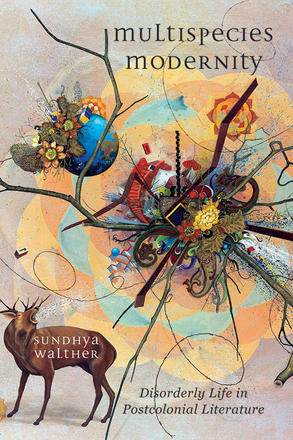
Multispecies Modernity is an original and readable book that brings together Animal Studies and Postcolonial Studies to focus on multispecies and interspecies representations in Literature, journalism and visual art. It argues that for the most part representations of animals in Postcolonial Literature are anthropomorphic and depend on oppositions between human and animal. The volume proposes that ‘India is a multispecies space’ and that the nonhuman presences in its literature are ‘more than figurative representations’. In bringing an Animal Studies perspective into play it aspires to ‘expand the ethical scope of postcolonial literature and theory and prevent the replication and perpetuation of colonial and neocolonial discourses of othering that affect both human and nonhuman animals’.
The work is rigorous in both its scholarship and its critical readings. The argument is significant in terms of its specific focus but also more broadly. Insightful, engaging, and rigorous, it makes important contributions to the study of postcolonial literature.
Xine Yao, Disaffected: The Cultural Politics of Unfeeling (Duke University Press).

Impressive in intellectual scope, this study reconceptualizes debates about sympathy and sentimentalism by reading a range of novels and short stories produced after Harriet Beecher Stowe, foregrounding minoritized voices. Driven by ‘the ethical charge to decolonize affect studies’, the book builds a complex methodological-theoretical framework, drawing on affect studies, queer theory, Black studies, Indigenous studies and Asian North American studies.
This monograph makes a distinctive and original contribution to a number of areas; Nineteenth-Century American Literature, Race and Literature, and Affect Studies. Not only is it a timely intervention but, perhaps more importantly, it is an uncomfortable intervention insofar as it addresses and poses some very difficult questions for any western reader. The work demonstrates real depth of scholarship; it engages with interesting and unexpected texts and shows a sophisticated grasp of both historical and theoretical context.


