
University English Book Prize 2019
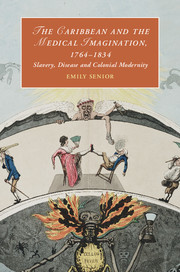
Winner
Emily Senior, The Caribbean and the Medical Imagination 1764-1834 (Cambridge University Press)
This is a compelling work, which clearly succeeds in its ambition to shift the angle of view in ‘medical humanities’: it rethinks the history of literature written in and about the Caribbean to show us how the medical knowledge indigenous and acquired there shaped ‘modern’ discourses of race, nation and climate. It turns our attention away from the abolitionist lens which has dictated our view of the colonial Caribbean and addresses the particularities of the Caribbean ‘as a set of localized material places with unique literary and cultural histories’ . While the book’s focus is on a specific locale its range is hugely impressive. For a literary scholar it gives new and timely insight into genres that have tended to be marked as ‘English’: the georgic, the pastoral, the sentimental novel. It shows us how suffused these genres are in fact with the encounter with the peoples, places –and above all the diseases –of the Caribbean. Senior’s book asks us to reimagine what we thought we knew about Empire, representation and the politics of genre in the eighteenth century. Every chapter takes the reader on a different imaginative trajectory and often in ways that are inspired. In particular, the chapter (three on ‘Skin and Colonial Feeling’) identifies the new ways in which skin came to be imagined in the eighteenth century through a fascinating reading of John Gabriel Stedman’s Narrative of a Five Years Expedition against the Revolted Negroes of Surinam (1790): as an organ rather than a container, as a site of feeling and of difference is wholly original and beautifully written, managing its own careful and sensitive relationship to troubling material. The book addresses a huge variety and number of literary and medical works, treating both kinds of writing with a forensic eye for detail, while building up an ambitious and wholly original argument. Erudite, well-written, expansive, yet detailed, it is likely to be a scholarly reference point for years to come.
Honourable Mention

Laura Eastlake, Ancient Rome and Victorian Masculinity
There is a high level of originality in this project, which looks at the influence and reception of ‘ancient Rome’ in Victorian England, with a strong focus on concepts and practices of masculinity. There are quite a few studies on links between Victorian writing and ancient Greece, but very little on classical Rome. The book’s approach, through the lens of gender studies, politics, and imperialism, is also innovative and gives the book a very clear direction and purpose as well as a wide appeal beyond literary studies in a narrow sense. One of the main arguments is that the British Empire, the bedrock of nineteenth-century identity and masculinity, was inevitably compared to, and to some extent modelled on, the Roman empire –or at least, what were regarded as its finest features, such as stoicism, bravery, and leadership. The book is significant for the scholarly community and for teachers, since it deals with canonical writers such as Collins and Trollope, putting them into context with less well-studied authors such as Pater and bringing forward new evidence and interpretations (such as Trollope’s engagement with Caesar and Roman history, and Pater’s efforts to redeem classical Roman society as less degenerate than was often represented). Finally, the book is extremely rigorous, showing a wide breadth and depth of scholarship and an effective methodology. The author has combed the archives, including letters, magazine and newspaper articles, and a great range of secondary criticism. The theoretical basis of her approach to masculinity is securely grounded in recent studies while moving forward to explore Victorian alternatives to the limited and conventional models of masculinity that were available at the time. The case studies, such as that of the reception of the Emperor Nero who was perceived as either monstrous or as an ideal of artistic masculinity, are both fascinating and well-argued.
Honourable Mention
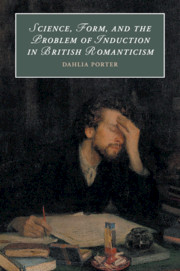
Dahlia Porter, Science, Form and the Problem of Induction in British Romanticism (Cambridge University Press)
This is a confident and ambitious work of analysis and argument. It offers a compelling account of induction’s emergence through the eighteenth century as the method for arriving at knowledge in an age increasingly aware of and fearful about saturation by information (equivalent to our own digital moment). It makes a significant contribution to debates over the history of the book, digital humanities and the interdisciplinary fields of histories of science and literature. Its blend of philosophical, interpretative and analytic work is persuasive and arresting, and – to single out one aspect of its many intricate details – the discussion of the prose-verse hybridity of Edgeworth and Smith was exceptional. More broadly, in tracing changing perceptions and anxieties about the composite in culture, the monograph offers a fascinating insight into taste, form, and style in the period. What rendered this book quite unique and particularly impressed the judging panel was the the links it made between induction as a scientific, philosophical and literary practice: in doing so, it not only helps trouble the distinction between empirical and creative thinking in significant ways, but caused us to reflect anew on how our own compositional and scholarly practices – textual evidence and selective quotation – have a cross-disciplinary history.


