
Reflections on lifelong learning
Richard J. Jones (The Open University)
Recently, I met a professor of eighteenth-century literature, who had been teaching for over fifty years. I was pleased to meet him, I explained, because his research into the lexicographer and poet Samuel Johnson had influenced me when I was younger. Johnson’s Dictionary of the English Language (1755) had captured my imagination! The professor told me that this is where had started, too. At that stage in his life, he said, he had been rapidly trying to catch up with the extent of Johnson’s learning. Now, many years later, he felt like he had at last caught up – in fact, he found that he was older now than Johnson had been when he was writing. Even though Johnson warns us that there is always something new to discover (‘Sir, you have not travelled over MY mind, I promise you’, he tells the writer Oliver Goldsmith), the professor hinted at how we might know each other better with a shared understanding of age.
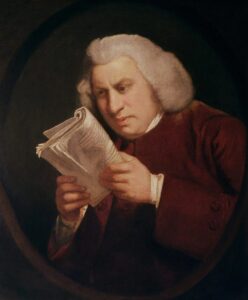
Samuel Johnson (1723–92) by Joshua Reynolds (1775), indicating a little short-sightedness. The Huntington Library.
How does ‘age’ influence reading, writing and thinking? We might think of ourselves as born into an age (the ‘Age of Enlightenment’, perhaps, or the ‘Age of Artificial Intelligence’) and we find ourselves taking on (or trying not to take on) characteristics associated with different ages: social, biological, or even cosmological. In his book Juvenescence (2014), Robert Pogue Harrison, explores the way that our Western culture today, despite continuing to age, is entranced by youth and becoming ever younger – something which, it might be said, harms the very youth that is being celebrated. This youth is going to find it harder to play catch-up with the learning of the past. If lifelong leaning means anything, it means approaching reading and writing – that is, noticing the linguistic world around us – through a renewed acceptance of age.


