
You Can
- Study the literature, language and creative writing you love to gain the futureproof skills you need for life, work and change.
- Make a difference through the choices you make. Embark on an English degree and let your creativity challenge the way the world works.
English creates crucial employment skills
Studying English at university can have a positive impact on your career prospects, with similar employability rates to those who studied STEM degrees.
English and English combined degrees, require students to learn and practice crucial skills in high demand by businesses and professional creative industries, helping them thrive and succeed in future employment. Skills such as:
- Communication (argument, persuasion, understanding your audience, self expression, performance)
- Critical thinking (the research skills which allow you to process, digest, evaluate, interrogate and manipulate complex material)
- Collaboration (teamwork, empathy, listening, responding)
- Oracy (the ability to express oneself with fluency, articulacy and persuasion)
- Creativity not only in writing and reading but also in thinking your way around issues and questions, what the market calls entrepreneurship.
These capabilities make English graduates better equipped to choose their own paths, and access a huge range of employment opportunities.
One report calls all this Storycraft, vital skills particularly valued by business leaders:
- Narrative communication
- Empathy and perspective taking
- Critical analysis
- Synthesis and managing complex data
- Creativity and imagination
- Digital skills.
English creates key contributions to the Creative Industries.
The creative industries are the fastest growing part of the UK economy. By 2030, it is expected that there will be 900,000 new jobs in this sector. According to the British Academy’s report Qualified for the Future on the industry demands for Arts and Humanities skills:
- 25% of SHAPE graduates work in the creative sector, which is currently worth £84.1bn to the UK (p.22).
English creates graduates that have competitive average starting salaries
Despite persistent myths surrounding employability and the salary prospects of English graduates, current figures show that the starting salaries for those qualifying with an English degree is on a par with many other subjects, including those in business and law.
The current figures from The Complete University Guide (2023) shows that:
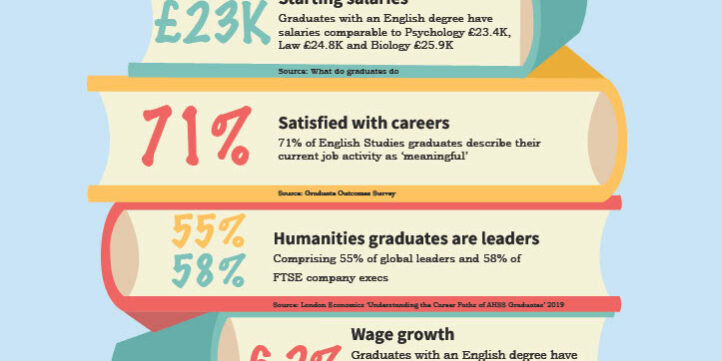
- starting salaries for graduates of English is £17,000-£23,000, comparable to subjects such as Psychology (£17680-23,000), Law (£22,000), Business Studies (£19,000-25,000) and Chemistry (£18.000- 25,000).
The Department of Education’s figures (p.6) in Qualified for the Future also shows that:
- English is joint fourth in terms of annual average wage growth. At 6.2%, compared to Physics (5.9%), Business (5.8%) and psychology (5.6%).
English creates graduates comprising global leaders and FTSE company execs
English and Humanities graduates go on to have not only great professional outcomes, but an economically resilient skill set and careers in leadership that have the potential for global impact. According to the report on AHSS graduates and their contribution to the economy by the consultancy group, London Economics:
- Humanities graduates comprise 55% of global leaders and 58% of FTSE company execs (p.ii).
- Evidence presented in the research by London Economics indicates ‘AHSS and STEM are often considered to develop very different sets of skills, yet the evidence presented here indicates that both types of skills are just as important to the labour market, irrespective of whether the economy is growing or contracting (p.39).
Graduates of Arts and Humanities have the same employment rate as graduates of STEM
Another myth to be busted is that English graduates are less employable than graduates with STEM degrees. In fact London Economics found that rates of employment are the same:
-
- 85% of women with AHSS and STEM degrees were in employment in the third quarter of 2017 (p.ii)
- 89% of men with an AHSS degree were in employment in the same period compared to 88% of male STEM graduate (p.ii).


