

Daniel Matore, The Graphics of Verse: Experimental Typography in Twentieth-Century Poetry (Oxford University Press, 2023)
Institutional Affiliation: York
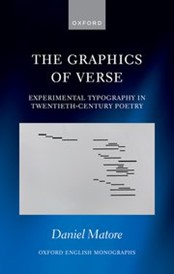
This is a brilliantly rigorous and meticulously researched book about typography and modernist poetry, which offers new perspectives on key literary debates about revision and materiality. Although focused on poetry written in English, The Graphics of Verse. Experimental Typography in Twentieth-Century Poetry notes from its introduction an interaction between this and precursor texts from wider European traditions and contexts beyond those of high culture. The ambitious claim of this detailed but highly engaging book, is that it points towards the early twentieth century as a time of ‘typological revolution’ in poetry written in English. As Matore asserts: ‘to design the layout of verse becomes second nature, a right that was neither taken for granted nor commonly exploited in previous centuries’ (8).
The chapters focus in turn on the work of cummings, Pound, and Olson, with each casting its net more widely to include acute encounters with a range of other poets including Marianne Moore, Hope Mirrlees, David Jones, and J H Prynne. With this structure, the book traces a fine history of the nuances between different practices in modernist poetics and is astute and compelling in some of its descriptions. It is a thorough and detailed take on metre, free verse and typography and although the book’s emphasis points of course to page space, including lineation and layout, it is very much concerned also with sound. The book builds compelling and consequential arguments about relationships between the eye and the ear in the making and reception of experimental poetry.
Each part of the argument works through sharply original readings of modern poetry, all of them deeply informed by exceptional knowledge of literary history and about the material histories and verse cultures in which the writing in focus emerged. It is rigorous in terms of its scholarship and employs a variety of methods including archival research, literary theory and criticism, typographical history and is designed to shed new light on Anglo-American poetics as it evolved in the wake of developments in typography. The book has a great deal to contribute to the field of Historical Poetics – a field just starting to get to work on modernisms – and to the growing body of scholarship in sound studies. The book’s conclusion points to the wider relevance of this approach. Overall, this is a fascinating and original book, which points to intersections between typography and psychology, linguistics, politics, and literature.
Congratulations to our 2023 shortlist!
Mary Batemen, Caitlin Stobie and Daniel Matore
Shortlist Overview
Mary Bateman, Local Place and the Arthurian Tradition in England and Wales, 1400-1700 (Cambridge University Press, 2023)
Institutional affiliation: Bristol
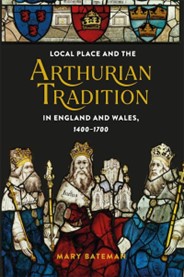
This is a fascinating book which traces the textual construction of Arthurian places and histories in the late medieval and early modern period. The book argues persuasively for a re-evaluation of the importance of Arthur in the emerging practices of antiquarianism in this period. In particular, Bateman proposes that the national and regional narratives of Arthur that we encounter in textual accounts of this period are mutually constitutive rather than mutually exclusive. It makes a significant contribution to Arthurian studies, is a rigorous study of place in the Arthurian legends and draws on a wide range of primary and secondary sources, providing an in-depth discussion of the places associated with Arthur between 1400-1700.
Bateman’s uncovering of touristic forms of mediating place is underpinned by her rigorous engagement with her primary materials: predominantly manuscript but also site-specific architecture and land formations. There is an engaging section in which Bateman brings to life the industry of more or less formal guided tours and what today might be understood as ‘signage’ in these sites. The book deploys very careful and thorough engagement with these sources to substantiate the claims it makes, often cross-referencing between a wide array of source material to develop its argument.
Caitlin Stobie, Abortion Ecologies in Southern-African Fiction: Transforming Reproductive Agency (Bloomsbury Academic, 2023)
Institutional Affiliation: Leeds
This monograph is a fascinating, nuanced and timely study of South African, Zimbabwean and Botswanan fictional materials on abortion covering the 1970s to 1990s, and includes texts by Wilma Stockenström, Zoë Wicomb, Yvonne Vera and Bessie Head. It approaches representations of abortion as a political and ethical issue at a moment of political transition. The book evocatively examines creation and creativity on multiple levels, both material and symbolic-metaphorical, and is a highly original piece of interdisciplinary scholarship.
The study is rigorous in its explication of terminology, methodological choices and textual analysis. There is an impressive array of new archival findings presented alongside published texts. It ambitiously combines methodological-theoretical frameworks from materialist feminism, new materialism, posthumanism/critical humanism, queer ecocritical theory and postcolonialism, all through an intersectional lens. The arguments cohere as a whole and methodologically are not to be faulted; literary analysis is also impressively contextualized in legal and social histories of abortion. The book also provides conceptual-analytical tools for understanding reproductive rights and politics in other cultural forms and national-geographical contexts. Offering new insights into the authors and texts under consideration as well as expanding existing critical-theoretical models, this is a book of high originality and significance.


