
2023 Winner
Noreen Masud, Stevie Smith and the Aphorism. Hard Language (Oxford University Press, 2022)
https://global.oup.com/academic/product/stevie-smith-and-the-aphorism-9780192895899?cc=gb&lang=en&
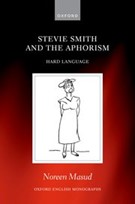
This book provides a significant scholarly contribution to our understanding of Stevie Smith’s poetry. The depth of research is impressive. The reader is immersed in scholarship on Smith and will be equally informed about the poet and her poetry. The extensive bibliography is testament to the depth of research, and the thorough index adds to the opinion that this is a book that has been extensively researched.
Masud’s book on the poetry of Stevie Smith is highly original, shows excellent rigour, and will be of significance to the fields of 20th century poetry, and language studies more broadly. Masud eloquently presents her arguments on the aphorism, showing superlative depth and breadth of understanding, and the book is a great pleasure to read.
2023 Shortlist
Doug Battersby, Troubling Late Modernism: Ethics, feeling and the novel form (Oxford University Press, 2022).
https://global.oup.com/academic/product/troubling-late-modernism-9780192863331?cc=gb&lang=en&
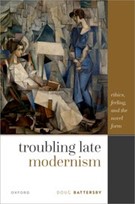
Following to a certain extent the work of Eve K. Sedgwick, Heather Love and David James, amongst others, but with a specific focus on question of form in a careful selection of six late modernist writers, this book offers a highly simulating, gratifyingly direct and bracingly original contribution to, what might now reasonably be called, the post-critical moment initiated by Rita Felski. Considering how readerly affect can be brought into line with aesthetic and formal considerations, Battersby carefully and rigorously demonstrates that there can be a productive reconciliation between the demands of epistemological excavation, on the one hand, and attention to the emotion and feelings produced by certain difficult forms, on the other.
Impressively clear-sighted and precise in method, the book’s contribution goes well beyond its readings of a handful of authors in offering a sophisticated, deeply researched and carefully balanced assessment of the state of literary criticism. This is a masterful, mature study whose arguments are conveyed with care and nuance.
Natalie Ferris, Abstraction in Post-War British Literature 1945-1980 (Oxford University Press, 2022).
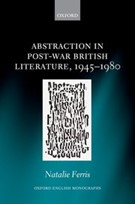
This book is a brilliant analysis of abstraction in British literature 1945-1980, illuminating different takes on the problem of whether and how a literary work makes meaning matters as much as what meaning it makes. It cites the thinking and practice of Herbert Read, Ian Hamilton Finlay and an impressive number of less well-known journals, workshops, bookshops and publishers in the context of international art movements, claiming a central place for the literary in the turn to abstraction. This is conceptually difficult territory, over which Ferris demonstrates her authority with aplomb. It contributes original insights into the inter-artistic development of abstraction, makes a significant intervention into studies of mid-century literary-artistic movements and displays rigour in the impressive range of its scholarship, its impeccable research and its beautiful close readings.
Overall, the fine-grained research into the particular contexts of a wide variety of texts is really compelling and the range of reference points is hugely impressive.
Alison Knight, The Dark Bible. Cultures of Interpretation in Early Modern England (Oxford University Press, 2022).
https://global.oup.com/academic/product/the-dark-bible-9780192896322?cc=gb&lang=en&
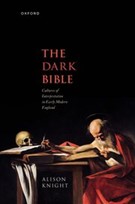
The most distinctive feature of The Dark Bible is the rigour of its scholarship. Alison Knight draws on a daunting range of manuscript and printed theological, historical, and literary sources from biblical antiquity to the early modern period, an achievement possible because of her facility in ancient languages (Latin, Greek, and Hebrew). Her engagement with contemporary scholarship is thorough and well-judged.
The significance of The Dark Bible lies in its direct look at a problem that had been recognized for centuries but which the early modern period encountered with particular urgency when the Bible was translated into English: how to handle those biblical passages that are ‘dark’, that is, not plain to the understanding. What is original about The Dark Bible is not its positing of a fresh overarching argument or its use of a new method of approaching the subject. Rather, it lies in its systematic investigation of the categories of interpretive darkness encountered (contradiction, ambiguity, defects, disorder, idiom, figures) and resolved by early modern translators of the English Bible.
Robert Stagg, Shakespeare’s Blank Verse. An Alternative History (Oxford University Press, 2022)
https://global.oup.com/academic/product/shakespeares-blank-verse-9780192863270?cc=gb&lang=en&
 This is a fine and original history of what seems to be an arcane and traditional subject: blank verse, and its relationship to other verse forms, including rhyme. Indeed, many of the skills of traditional close reading are productively on display in this first book-length study of this verse form as it hardened into ‘blank verse’.
This study ranges well beyond the narrow confines of versification in that it attempts (successfully) to trace metrical meanings and significance in a variety of authors and styles. Its scope is impressive and the “escape from rhyme” is not only demonstrated but explained –especially in chapter 4 where the fate of the earliest critical evaluations is re-assessed carefully and in detail. In short, this is deeply researched and adds an element to Shakespeare studies often neglected: estimates of how contemporaries valued, or devalued, metrical variety and through such means how characterisation and thematic stress was communicated.


